01 Rudiments
Military signalling, the standard lists, and the sampler
A rudiment is a short sticking pattern a drummer drills until it is automatic, then builds music from: which hand plays, how loud, and what ornaments lead into the stroke. They began as military signalling. Fife and drum carried orders across a field, so the patterns had to be distinct, repeatable and teachable, and every army wrote its own. The list most drummers learn was fixed twice in the twentieth century, by the National Association of Rudimental Drummers in 1933 and by the Percussive Arts Society in 1984. [2]
Then the samplers arrived. Breaks played by soul and funk drummers in 1969 and 1970 were lifted, sped up and cut into pieces until they played phrases no drummer had played, and by 2001 drummers were learning to play those edits back on an acoustic kit. The second half of the timeline is that loop: from the hands to the machine and back to the hands. [4]
Six centuries of writing drumming down
-
1386
Sempach signal
Swiss fife and drum play at the battle of Sempach, the instance usually cited as the beginning of rudimental drumming. Drums carried orders across a field. [2]
-
1589
Arbeau signal
Orchésographie, a dance manual by Thoinot Arbeau, describes the military drum. It is often called the first rudimental text, though it notates very little. [2]
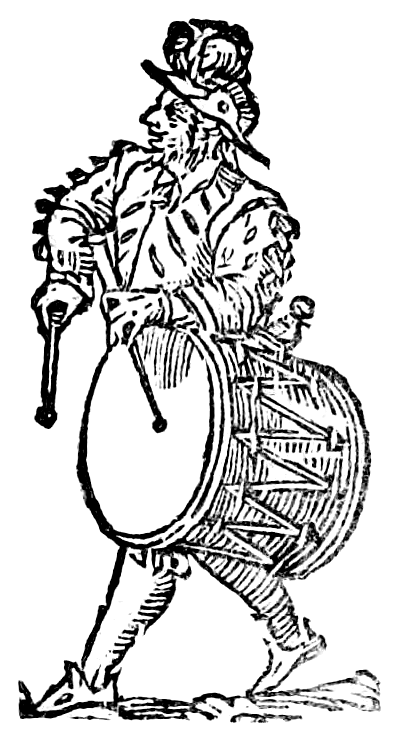
The drummer of Orchésographie (1589), f. 7r. Thoinot Arbeau. Public domain, via Gallica and Wikimedia Commons -
1634
Fisher signal
Fisher's Warlike Directions is the earliest British manual whose rudiments can be read; at least four of them are built on the ruff. [2]
-
1812
Ashworth signal
Charles Stewart Ashworth is the first to call short drum exercises 'rudiments'. [2]
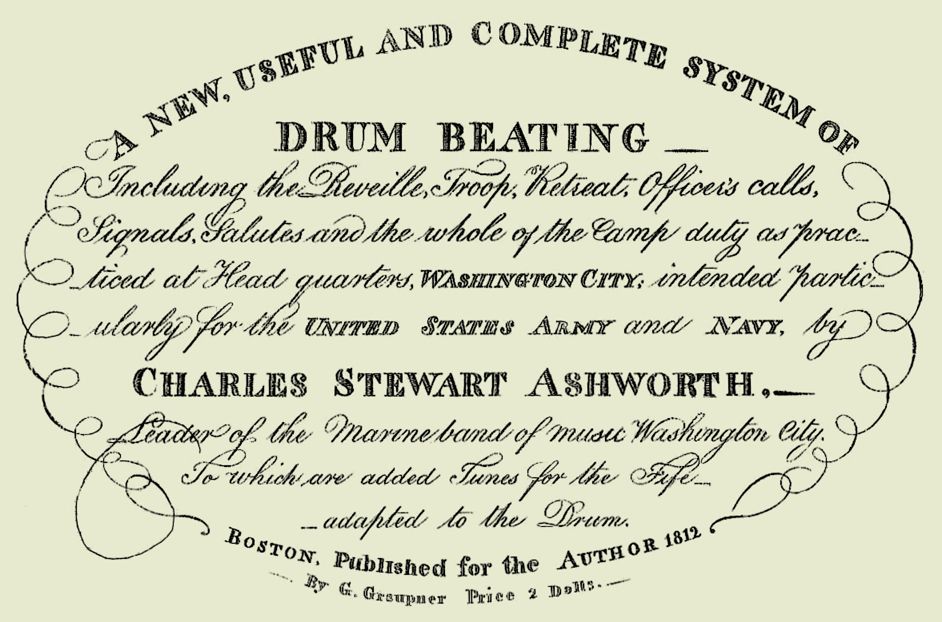
Ashworth's system of drum beating, 1812: the first book to call its exercises rudiments. Charles Stewart Ashworth. Public domain, via Wikimedia Commons -
1862
Bruce and Emmett signal
Bruce and Emmett publish The Drummers' and Fifers' Guide, one of the drum manuals of the American Civil War. [2]
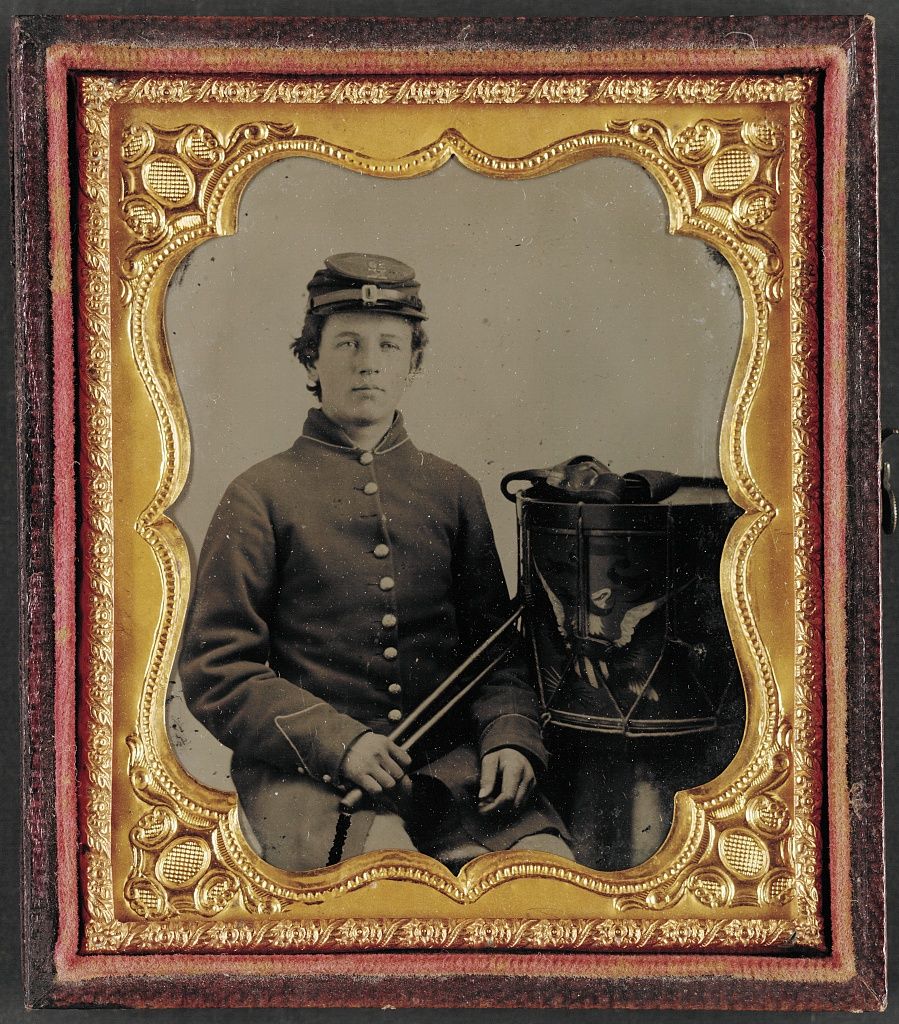
An unidentified drummer boy in Union uniform, between 1861 and 1865. Library of Congress, no known restrictions, via Wikimedia Commons -
1869
Strube signal
Gardiner A. Strube distils Civil War practice into an influential list. [2]
-
1925
Moeller standard
Sanford Moeller publishes one of the few lists meant for civilian drummers, with a method that looks back to the 'ancient' military technique. [2]
-
1928
Berger standard
Fritz Berger publishes Das Basler Trommeln. Basel had written its drumming in its own symbols; Berger's notation could be read abroad, and he brought it to the United States in the 1930s. [2]
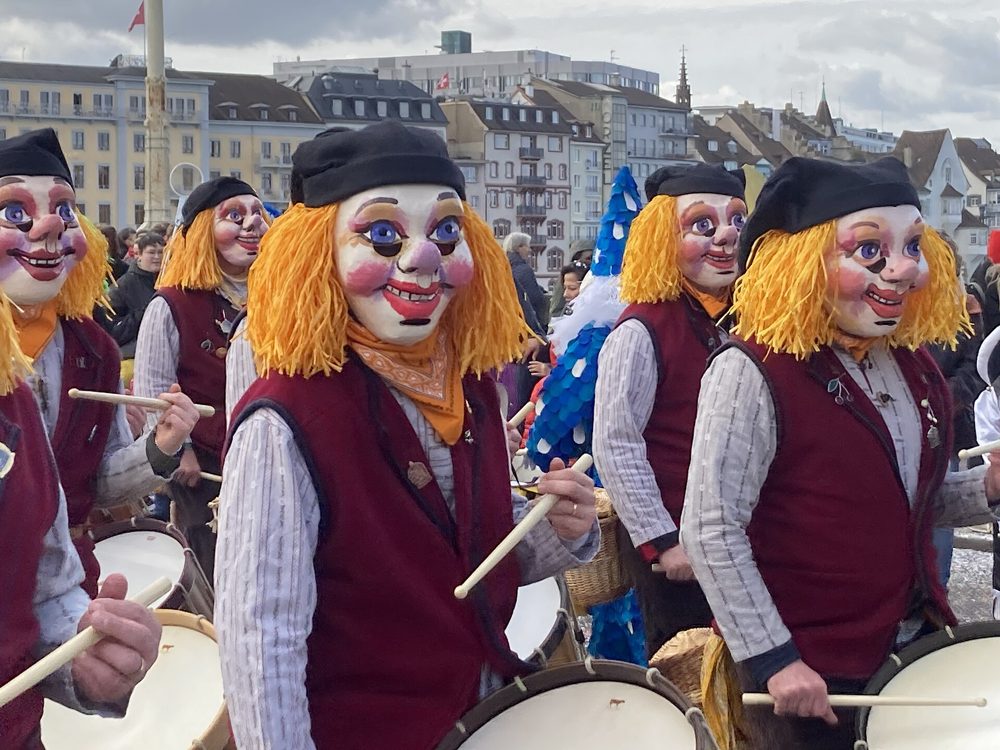
Basel drummers at the Fasnacht, 2024: the tradition Berger wrote down. Photo: Beat Ruest, CC BY-SA 4.0, via Wikimedia Commons -
1933
NARD standard
The National Association of Rudimental Drummers fixes the Standard 26: thirteen essential rudiments and thirteen more. [2]
-
1969
Amen, Brother break
The Winstons put out a B-side with a four-bar drum break by Gregory Coleman, about seven seconds long. The band was never paid for what happened to it next. [3]
-
1970
Funky Drummer break
Clyde Stubblefield plays the groove for James Brown. It is later sampled everywhere, sped up, and rarely credited. [4]
If I was an important element to the music, please acknowledge me.Clyde Stubblefield, interviewed by Johnny Rabb, 2001
-
1984
PAS standard
The Percussive Arts Society reorganises the 26 and adds 14 drum corps, orchestral, European and contemporary rudiments: the 40 International Drum Rudiments. [1]
-
1986
Ultimate Breaks and Beats break
A compilation of breaks for DJs puts the Amen on turntables, and from there into hip hop. [3]
-
1990s
Jungle break
UK producers sample the old breaks, speed them up to 160 bpm and beyond, cut them into pieces as short as a beat, and resequence them on samplers. Sped up, the drums come out higher; chopped, they play phrases no drummer played. The jungle edit is RUDE's Chop. [4]
-
2001
Rabb break
Johnny Rabb's Jungle/Drum 'n' Bass for the Acoustic Drum Set teaches the chopped breaks back to the hands, at 140 to 180 bpm: grooves built from one-beat 'fragments', three snares tuned to sound like sped-up samples, buzz rolls for electronic rolls. The machine's edit becomes a rudiment again. [4]
-
2026
RUDE now
RUDE takes two rudiments, breeds a third from them, and plays it as General MIDI.
_drummer_illustration_(f._7r).png)


.jpg)
signal military practice and its manuals standard the lists break the sampler and back now
The four families
| Family | PAS numbers | What the hands do |
|---|---|---|
| Rolls | 1 to 15 | sustain: single strokes, multiple bounce, or doubles; most are named for their stroke count |
| Diddles | 16 to 19 | a double stroke inside a single-stroke pattern: the paradiddles |
| Flams | 20 to 30 | one grace note from the other hand just ahead of the stroke |
| Drags | 31 to 40 | two grace notes ahead of the stroke, a double at twice the speed |
02 Strokes
A notation drummers can already read
Drummers already have a notation that fits on one line: the sticking, R and L under the notes, small letters for grace notes, a wedge for an accent. RUDE reads that notation directly. Each token is one step of a grid, and the grid's steps per beat belong to the rudiment: a flam accent is counted in triplets, a paradiddle in sixteenths. The table is the whole grammar; a pattern that breaks it is refused with the column of the offending character.
| Text | Means | Example |
|---|---|---|
R L K @ | a stroke: right hand, left hand, kick, call (a voice) | R L R R |
r l k | grace notes, played ahead of the step's first stroke | lR flam, llR drag, lrlR ruff |
> | the next stroke is accented | >lR, an accented flam |
( ) | ghost strokes, as quiet as a stroke gets | (R) L (R) (R) |
~ | a buzz: the stroke bounces as several decaying hits | R~ L~ |
RR | two strokes divide the step: a diddle, at twice the speed | RR LL >R |
R+L | a double stop, both at once; R+K is a hand with the kick | >R+K L |
R.R | inside a step, . is a silent part: a triplet with a hole | R.R L |
- or . alone | a rest step | R - - L |
Nine strokes, as the engine times them at 120 bpm
tapR
accent>R
ghost(R)
flamlR
dragllR
4-stroke rufflrlR
diddleRR
buzzR~
double stopR+L
03 Specimens
The library: 119 patterns
Every entry is the loop RUDE plays, drawn from the engine's own output: both sides of an alternating rudiment, so the loop lands where it started. Large dots are accents, small dots taps, open dots ghosts, two dots in a step a diddle, a zigzag a buzz; grace notes are the accent colour, drawn just ahead of their stroke and not to scale. 11 of the 119 entries were reconstructed from a written description rather than read off a chart, and are marked (r). [1] [5] [6] The 35 Carnatic talas are a table in section 07, not 35 cards here.
Rolls PAS 1 to 15
01 Single Stroke Roll
4/beat · 8 steps
R L R L R L R L
02 Single Stroke Four
6/beat · 12 steps
>R - - R L R >L - - L R L
03 Single Stroke Seven
6/beat · 24 steps
R L R L R L >R - - - - - L R L R L R >L - - - - -
04 Multiple Bounce Roll
4/beat · 8 steps
R~ L~ R~ L~ R~ L~ R~ L~
05 Triple Stroke Roll
6/beat · 6 steps
R R R L L L
06 Double Stroke Open Roll
4/beat · 8 steps
R R L L R R L L
07 Five Stroke Roll
4/beat · 8 steps
RR LL >R - LL RR >L -
08 Six Stroke Roll
4/beat · 8 steps
>R LL RR >L >R LL RR >L
09 Seven Stroke Roll
6/beat · 12 steps
LL RR LL >R - - RR LL RR >L - -
10 Nine Stroke Roll
4/beat · 16 steps
RR LL RR LL >R - - - LL RR LL RR >L - - -
11 Ten Stroke Roll
4/beat · 8 steps
RR LL RR LL >R >L - -
12 Eleven Stroke Roll
4/beat · 16 steps
RR LL RR LL RR >L - - LL RR LL RR LL >R - -
13 Thirteen Stroke Roll
4/beat · 16 steps
RR LL RR LL RR LL >R - LL RR LL RR LL RR >L -
14 Fifteen Stroke Roll
4/beat · 16 steps
RR LL RR LL RR LL RR >L LL RR LL RR LL RR LL >R
15 Seventeen Stroke Roll
4/beat · 24 steps
RR LL RR LL RR LL RR LL >R - - - LL RR LL RR LL RR LL RR >L - - -
Diddles PAS 16 to 19
16 Single Paradiddle
4/beat · 8 steps
>R L R R >L R L L
17 Double Paradiddle
6/beat · 12 steps
>R L R L R R >L R L R L L
18 Triple Paradiddle
4/beat · 16 steps
>R L R L R L R R >L R L R L R L L
19 Paradiddle-diddle
6/beat · 12 steps
>R L R R L L >R L R R L L
Flams PAS 20 to 30
20 Flam
2/beat · 4 steps
lR rL lR rL
21 Flam Accent
3/beat · 6 steps
>lR L R >rL R L
22 Flam Tap
4/beat · 8 steps
>lR R >rL L >lR R >rL L
23 Flamacue
4/beat · 16 steps
lR >L R L lR - - - rL >R L R rL - - -
24 Flam Paradiddle
4/beat · 8 steps
>lR L R R >rL R L L
25 Single Flammed Mill
4/beat · 8 steps
>lR R L R >rL L R L
26 Flam Paradiddle-diddle
6/beat · 12 steps
>lR L R R L L >rL R L L R R
27 Pataflafla
4/beat · 8 steps
>lR L R >rL >lR L R >rL
28 Swiss Army Triplet
3/beat · 6 steps
>lR R L >lR R L
29 Inverted Flam Tap
4/beat · 8 steps
lR L rL R lR L rL R
30 Flam Drag (r)
4/beat · 12 steps
>lR - L L R - >rL - R R L -
Drags PAS 31 to 40
31 Drag
2/beat · 4 steps
llR rrL llR rrL
32 Single Drag Tap
2/beat · 4 steps
llR >L rrL >R
33 Double Drag Tap
3/beat · 6 steps
llR llR >L rrL rrL >R
34 Lesson 25
4/beat · 8 steps
llR L >R - llR L >R -
35 Single Dragadiddle (r)
4/beat · 8 steps
>RR L R R >LL R L L
36 Drag Paradiddle No. 1
6/beat · 12 steps
>R llR L R R - >L rrL R L L -
37 Drag Paradiddle No. 2 (r)
8/beat · 16 steps
>R llR >R llR L R R - >L rrL >L rrL R L L -
38 Single Ratamacue
4/beat · 8 steps
llR L R >L rrL R L >R
39 Double Ratamacue
4/beat · 16 steps
llR llR L R >L - - - rrL rrL R L >R - - -
40 Triple Ratamacue
4/beat · 16 steps
llR llR llR L R >L - - rrL rrL rrL R L >R - -
Hybrids drum corps
41 Cheese
4/beat · 4 steps
lRR rLL lRR rLL
42 Herta
4/beat · 8 steps
RL R LR L RL R LR L
43 Eggbeater
5/beat · 10 steps
R R R L L L L L R R
44 Cheese Pataflafla (r)
4/beat · 8 steps
lRR L R rL lRR L R rL
45 Flam Five (r)
5/beat · 10 steps
>lR L R L R >rL R L R L
46 Inverted Paradiddle
4/beat · 8 steps
>R L L R >L R R L
47 Mill Stroke
4/beat · 8 steps
>R R L R >L L R L
Swiss and Basel
48 Doublé (Basel) (r)
3/beat · 12 steps
>rL R >lR L >rL R >lR L >rL R >lR L
49 Tagwacht / Reveille Stroke (r)
4/beat · 8 steps
llR llR >L - rrL rrL >R -
50 3-Stroke Ruff
2/beat · 4 steps
rlR lrL rlR lrL
51 4-Stroke Ruff
2/beat · 4 steps
lrlR rlrL lrlR rlrL
52 Swiss Army Triplet, Alternating (r)
3/beat · 12 steps
>lR R L >lR R L >rL L R >rL L R
Timelines and figures outside the canon
53 Tresillo E(3,8)
4/beat · 8 steps
R - - L - - R -
54 Cinquillo E(5,8)
4/beat · 8 steps
R - L R - L R -
55 Son Clave 3-2
4/beat · 16 steps
R - - R - - R - - - L - L - - -
56 Rumba Clave 3-2
4/beat · 16 steps
R - - R - - - R - - L - L - - -
57 Ewe Bell E(7,12)
3/beat · 12 steps
>R - R - R R - R - R - R
58 Clapping Music (Reich)
3/beat · 12 steps
R R R - R R - R - R R -
59 Kotekan (interlock) (r)
4/beat · 16 steps
R L R R L R L R R L R R L R L R
60 Konnakol Khanda (5)
5/beat · 10 steps
>R L R L R >L R L R L
61 Konnakol Misra (7)
7/beat · 14 steps
>R L R >L R L R >L R L >R L R L
62 Noh Hon-ji (sketch) (r)
2/beat · 16 steps
L @ L @ >R - L >@ L @ L @ >R @ L >@
67 Rachenitsa 7 (2+2+3)
2/beat · 14 steps
>R L >R L >R L R >L R >L R >L R L
68 Daychovo 9 (2+2+2+3)
2/beat · 18 steps
>R L >R L >R L >R L R >L R >L R >L R >L R L
69 Kopanitsa 11 (2+2+3+2+2)
2/beat · 22 steps
>R L >R L >R L R >L R >L R >L R >L R >L R L >R L >R L
70 Maqsum (Arabic)
2/beat · 8 steps
>K R - R >K - R -
71 Jhaptal 10 (2+3+2+3)
2/beat · 10 steps
>R L >R L R (L) R >L R L
118 Diketo (24) (r)
3/beat · 24 steps
>R - R - R - R - R R - R - R - R - R - R - R R -
119 Aka Oddity 24
3/beat · 24 steps
>R - - R - R - R - R - R - - R - R - R - R - R -
Linear hands and feet
63 Linear RLK
3/beat · 6 steps
R L K R L K
64 Linear RLRK
4/beat · 8 steps
>R L R K >L R L K
65 Paradiddle with Feet
4/beat · 8 steps
>R L K K >L R K K
66 Gallop
6/beat · 12 steps
>R L K - - - >R L K - - -
Xeno made by a rule, or invented
72 Fibonacci Word (13:8)
3/beat · 21 steps
R L R R L R L R R L R R L R L R R L R L R
73 Thue-Morse (16)
4/beat · 16 steps
R L L R L R R L L R R L R L L R
74 Golden Euclid E(8,13)
2/beat · 26 steps
>R R - R R - R - R R - R - >L L - L L - L - L L - L -
75 Prime Pulses (under 30)
6/beat · 30 steps
- - >R R - R - R - - - R - R - - - R - R - - - R - - - - - R
76 Nine-Step Cycle (4+5)
3/beat · 18 steps
>R L R L >R L R L R >L R L R >L R L R L
Usul Turkish, düm and tek
112 Aksak 9/8
2/beat · 18 steps
>K - >R L >K - >R - L >K - >R L >K - >R - L
113 Curcuna 10/8
2/beat · 10 steps
>K - L >R - >K - >R - L
114 Düyek 8/8
2/beat · 8 steps
>K >R - >R >K - L -
115 Semai 3/4
1/beat · 3 steps
>K >R L
116 Sofyan 4/4
1/beat · 4 steps
>K - >R L
117 Türk Aksağı 5/8
2/beat · 10 steps
>K - >R - L >K - >R - L
04 Timelines
Euclid's algorithm, and rhythms as necklaces
Outside the rudiment books, much of the world's drumming hangs on a timeline: a short asymmetric pattern, often on a bell or claves, that the other parts orient to. Godfried Toussaint showed in 2005 that many are what Euclid's algorithm for the greatest common divisor produces when it is asked to spread k onsets as evenly as possible over n steps, written E(k, n). The tresillo is E(3, 8), the cinquillo E(5, 8), the West African 12/8 bell pattern E(7, 12): maximally even, and therefore never quite even. [7]
Drawn on a circle, a timeline's shape shows at once, and so does a rotation: the same necklace started at a different bead is a different rhythm. RUDE's Rotate does exactly that.
Tresillo3 of 8, E(3,8)
Cinquillo5 of 8, E(5,8)
Ewe Bell7 of 12, E(7,12)
Son Clave 3-25 of 16
Clapping Music8 of 12
05 Breeding
Seven blends and a chop
A hybrid rudiment is two rudiments combined into a third (the cheese is a flam on a diddle), and drum corps have invented hundreds. RUDE makes the combining a control. Rudiment A and Rudiment B go into one of seven blends, or Chop cuts A on its own, and Mutate, Rotate, Reverse and Invert then work on the result. Blends count steps, not time, so B is played on A's grid: a triplet rudiment blended into a sixteenth one is squeezed into sixteenths, on purpose. That changes the rhythm itself, and it is where the strange ones come from.
When A and B differ in length, the step-wise blends loop at their least common multiple, so both come round together: a paradiddle (8 steps) hocketed with a Swiss army triplet (6) is a 24-step loop. Chop is the jungle producer's edit, a break cut into beats and resequenced; it is also Johnny Rabb's approach: grooves assembled from one-beat fragments, which he says you cannot mess up. [4]
Chain
A then B.
ASingle Paradiddle
BFlam Tap
=result
Splice
A's first half, B's second half.
ASingle Paradiddle
BFlam Tap
=result
Chimera
beat-long pieces, each from A or B; Amount is the chance of B.
ASingle Ratamacue
BCheese
=result
Morph
step by step from A or B; Amount is the chance of B.
ASingle Ratamacue
BCheese
=result
Hocket
Interlocks A's right hand with B's left, the way two kotekan parts make one line.
ASingle Paradiddle
BSwiss Army Triplet
=result
Graft
B decides where and which hand, A decides what kind of stroke.
AFlam Paradiddle
BSon Clave 3-2
=result
Duet
Plays A on the right-hand voice and B on the left at once; unequal lengths make a polymeter.
ATresillo E(3,8)
BEwe Bell E(7,12)
=result
Chop
Cuts A into beats and puts them back in a seeded order: the jungle edit.
ASingle Ratamacue
=result
Mutate
Each plain stroke may gain a flam, drag, diddle, accent, buzz or ghost, or become a rest.
ASingle Paradiddle
=result
06 Noh
The hayashi: drums, calls and the eight-beat frame
The Noh ensemble, the hayashi, is a flute and three drums: the shoulder drum (kotsuzumi), the hip drum (ōtsuzumi) and, in some plays, a stick drum (taiko). Chant and drums share an eight-beat frame, the honji. The drummers also call. Their kakegoe (the hip drum's yo, ho, iya, yo-i and hon-yo; the shoulder drum's yo, ho and iya) are part of the rhythm and the way two players who never look at each other keep time. In a strict setting the calls sit centred between beats; in a flexible one they start earlier and can fill the space between beats. The hip drum is busiest in the first four beats, the shoulder drum in the last four. [11] In one Stanford analysis, of the notto passage in Kokaji, most lines fit between successive strong 'chon' strokes of the hip drum, which fall on the honji's third beat. [10] RUDE's entry is our sketch of this: an accented yo before beats 1 and 5, a ho before the others, and a second chon on beat 7. Which call falls where is our choice, not the source's. [9] [13]
The hip drum's head is dried over charcoal before a performance to make it hard enough for that dry crack. RUDE's Noh entry is a sketch of the frame, not a piece: placements differ between schools and passages, and the timing stretches, the space called ma, in a way no grid holds.
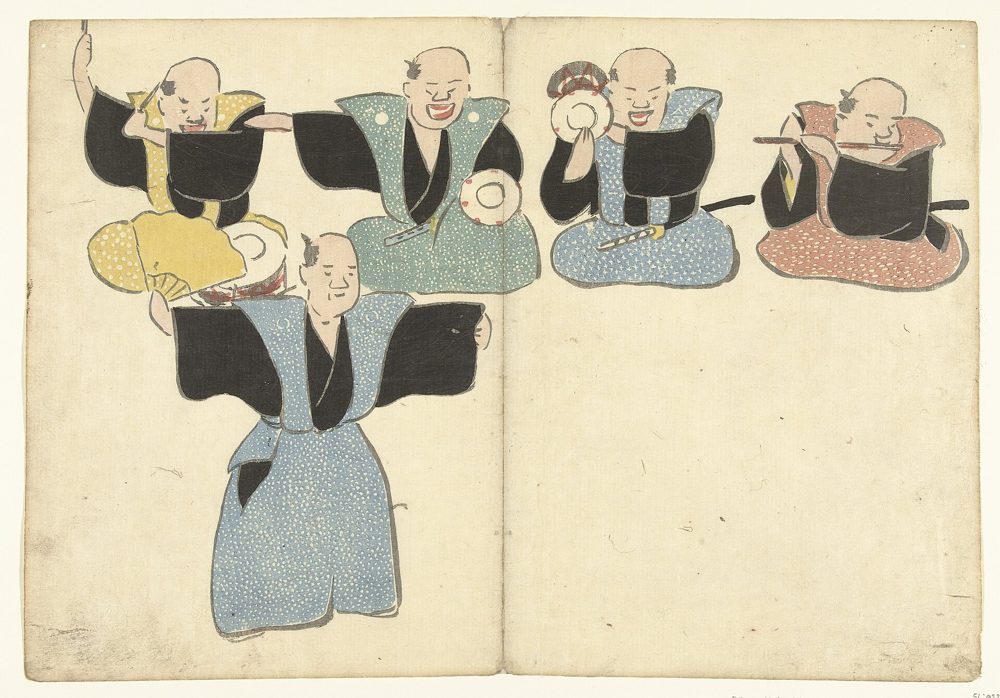
_Korin_gafu_(serietitel),_RP-P-1951-932-13.jpg)
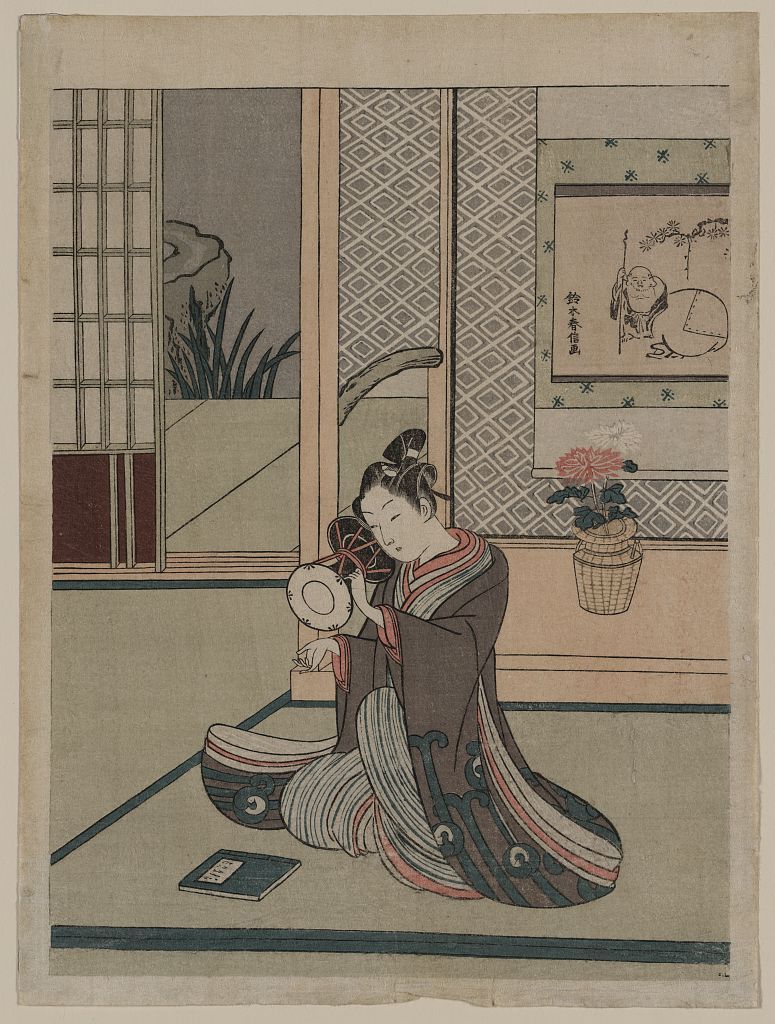

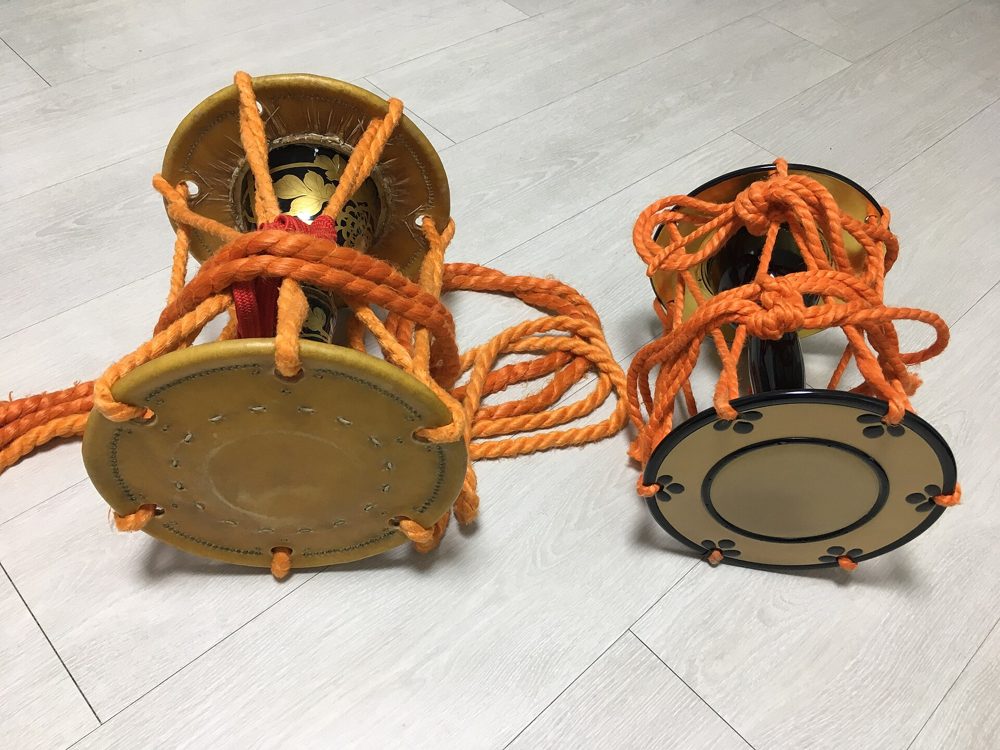

The shoulder drum's five sounds, and the hip drum's strong stroke
| Drum | Sound | Register | Strength |
|---|---|---|---|
| kotsuzumi | po | low | strong, the open resonant stroke |
| kotsuzumi | pu | low | weak |
| kotsuzumi | ta | high | strong |
| kotsuzumi | chi | high | weak |
| kotsuzumi | tsu | no resonance | |
| ōtsuzumi | chon | high | strong, sharp: the dried head |
07 Xeno
Uneven meters, tala and usul, film aliens, and rhythms from a rule
Plenty of the world's drumming does not count in fours. Bulgarian and Turkish dance music limps: the aksak meters group a fast pulse into twos and threes, so a bar of seven goes 2+2+3 and the long step falls at the end. A Hindustani tala is counted in claps and waves, and Jhaptal's ten beats are clapped on 1, 3 and 8, with a wave of the hand, the khali, on 6. The Arabic maqsum is two dums and three teks. RUDE has an entry for each, written so that the loop is a whole number of beats: the aksak bars play twice, the second time from the other hand. [15] [16] [17]
Film composers are sometimes asked for the music of people who do not exist. For Avatar, James Horner worked with the ethnomusicologist Wanda Bryant, who drafted a musical culture for the Na'vi: what they sing, what they make instruments from, where music sits in their lives. [18] For Dune, Hans Zimmer asked his players to invent instruments that do not exist; for Part Two, Pedro Eustache invented a chromatic duduk, and Loire Cotler's wordless voice draws on konnakol, jazz scat, overtone singing and vocal percussion. [19] [20] Close Encounters of the Third Kind kept its alien music small. Its greeting is five notes because Spielberg wanted a short greeting, and John Williams wrote some 350 five-note candidates. [21] Marc Okrand gave Klingon music a nine-tone scale, and one blog series has built a theory on it. [22]
None of these accounts says how an alien drummer would count, so the Xeno family makes some rhythms by rule. The Fibonacci word grows by replacing each R with RL and each L with R; carried on forever, it never repeats, and RUDE loops its first 21 strokes, 13 R to 8 L. Thue-Morse gives a step to L when its number, written in binary, has an odd count of 1s, and to R otherwise; even looped, no figure shorter than the loop plays three times running. E(8, 13) spreads 8 onsets over 13 steps; 8 and 13 are consecutive Fibonacci numbers, so their ratio is close to the golden ratio. Prime Pulses strikes on the steps whose numbers are prime, counting the first step as 0, up to 29. The nine-step cycle, 4 + 5, is invented: Okrand gave the Klingons nine tones and nothing about their rhythm, so this is a guess at what nine would sound like on a drum.
Carnatic tala, Turkish usul and the Aka
A Carnatic tala is kept with one hand. A laghu is a clap and finger counts, 3, 4, 5, 7 or 9 in all (the jati); a drutam is a clap and a wave; an anudrutam a single clap. Seven families fix the order of the parts and five jatis the laghu, so there are 35 talas, from 3 beats to 29. Adi tala, the commonest, is a laghu of four and two drutams: clap, three fingers, clap, wave, clap, wave. RUDE plays the hand, claps accented and waves as ghosts. [23]
| Family | Parts | Tisra 3 | Chatusra 4 | Khanda 5 | Misra 7 | Sankeerna 9 |
|---|---|---|---|---|---|---|
| Eka | laghu | 3 | 4 | 5 | 7 | 9 |
| Rupaka | drutam laghu | 5 | 6 | 7 | 9 | 11 |
| Triputa | laghu drutam drutam | 7 | 8 Adi | 9 | 11 | 13 |
| Matya | laghu drutam laghu | 8 | 10 | 12 | 16 | 20 |
| Jhampa | laghu anudrutam drutam | 6 | 7 | 8 | 10 | 12 |
| Ata | laghu laghu drutam drutam | 10 | 12 | 14 | 18 | 22 |
| Dhruva | laghu drutam laghu laghu | 11 | 14 | 17 | 23 | 29 |
A Turkish usul is a cycle of strokes, the low düm and the lighter teks. RUDE's six come from the stroke weights in Holzapfel and Bozkurt's study, with the düm on the kick; düyek keeps its first two strokes in the order every notation gives them, where the study's figure swaps them. [24] In Central Africa, Simha Arom found that many Aka timelines cannot be cut into two equal halves: no two strokes sit exactly half a cycle apart, so no cut at two strokes gives equal halves. He called this rhythmic oddity. Chemillier and Truchet open their enumeration of such rhythms with an Aka pattern of 24 pulses, 3 2 2 2 2 3 2 2 2 2 2, and RUDE carries it. [26]
So that 35 talas do not crowd out 5 xeno patterns, ROLL picks a family first and only then an entry, and the dot on each family's tab takes it in or out of the draw.
Uneven meters
accents mark the groups
Rachenitsa 7 (2+2+3)7/8 · 2+2+3
Daychovo 9 (2+2+2+3)9/8 · 2+2+2+3
Kopanitsa 11 (2+2+3+2+2)11/8 · 2+2+3+2+2
Maqsum (Arabic)D T - T D - T -
Jhaptal 10 (2+3+2+3)10 · 2+3+2+3
Usul, tala and the Aka
düm on the kick; claps accented, waves as ghosts
Aksak 9/89 · düm te ke düm tek tek
Curcuna 10/810/8
Düyek 8/88/8
Semai 3/43/4
Sofyan 4/44/4
Türk Aksağı 5/85/8
Chatusra Triputa 8 (Adi)tala · clap, 3 fingers, clap, wave, clap, wave
Aka Oddity 243 2 2 2 2 3 2 2 2 2 2 · Arom
Xeno
each row is checked against its rule
Fibonacci Word (13:8)R to RL, L to R
Thue-Morse (16)L where the step has odd 1s
Golden Euclid E(8,13)8 onsets in 13 steps
Prime Pulses (under 30)prime steps, from 0
Nine-Step Cycle (4+5)4 + 5, invented
08 Phase
Clapping Music as a setting
Steve Reich's Clapping Music (1972) is two players and one twelve-beat pattern: three claps, two, one, two, each followed by a rest. One player repeats it unchanged. The other, after a number of repeats, jumps one eighth note ahead, and keeps doing so until, twelve shifts later, the two are back in unison. In his earlier tape pieces two loops drift apart continuously; here the shift is abrupt, one eighth at a time, which two people clapping can actually do. [8]
In RUDE the piece is a setting: Clapping Music as both A and B, the Duet blend, and Drift, which moves B one more step every N loops. From row to row neither part changes; where they coincide does, and that is what a listener hears: the resulting patterns of the combined line.
09 To MIDI
Notes in, General MIDI drums out
RUDE has no audio. It is a note effect: notes in, notes out, and the drum machine or sampler after it makes the sound. Every stroke becomes a General MIDI note on channel 10, on its voice's key: by default both hands on the acoustic snare (38), the kick on 36, the call on the mute cuica (78). A Voicing control moves the hands around the kit. [14]
Two details decide whether a pattern sounds right. A grace note is a separate note on the same key as its stroke, so with a 40 ms gate the grace is still held when the stroke arrives; a key cannot be struck while it is down, so the plugin releases it first, at the same instant. And a stroke that falls exactly on the edge between two audio blocks belongs to the block holding its nearest sample. The first build truncated instead and put such strokes one sample early, in the wrong block, where host rounding could double or drop them. Both are tested against the built plugin at four combinations of block size and tempo.
10 Controls
Read from the source at build time
RUDE has 34 parameters, every one automatable. The panel's front page holds what you play with; keys, channel, dynamics and stroke timing are under ADVANCED. A host's own list shows Rudiment A and B, Blend and Voicing by name. Ranges and defaults are read from the plugin's source when this page is built.
| Control | Range, default | What it sets |
|---|---|---|
| Rudiment A | 119 entries | the first rudiment, chosen by name from the library. |
| Rudiment B | 119 entries | the second; the seven blends use it, A and Chop ignore it. |
| Blend | 9 settings, Hocket | A alone, seven blends (Chain to Duet), or Chop. |
| Amount | 0 to 100%, 50 | Chimera and Morph: the chance of taking B. Chop: the chance a beat is swapped. |
| Seed | 1 to 999, 1 | fixes every random choice; the same seed plays the same notes. |
| Evolve | off / on | reseed every loop, so the pattern keeps changing. |
| Mutate | 0 to 100%, 0 | the chance a plain stroke gains an ornament or becomes a rest. |
| Phase | 0 to 63, 0 | B starts this many steps in. |
| Drift | 0 to 32, 0 | B moves one more step every N loops. |
| Grid | 0 to 8, 0 | steps per beat; Natural is A's own. |
| Rate | 0 to 2, 1 | half, normal or double speed. |
| Rotate | 0 to 63, 0 | start the loop this many steps in. |
| Reverse | off / on | play the loop backwards; graces still lead their strokes. |
| Invert | off / on | swap the hands. |
| Swing | 0 to 50%, 0 | delay odd steps by this fraction of a step. |
| Trigger | hold / transport | Hold key: plays while a key is down. Transport: follows the host. |
| Voicing | 17 voicings | which GM keys the two hands play; Custom uses Note R and Note L. |
| Note R | 0 to 127, 38 | the right hand's key in Custom voicing. |
| Note L | 0 to 127, 38 | the left hand's key in Custom; with a key held, its offset from the held key. |
| Kick note | -1 to 127, 36 | the K voice's key, or off. |
| Call note | -1 to 127, 78 | the @ voice's key, or off. |
| Channel | 1 to 16, 10 | MIDI channel; 10 is General MIDI percussion. |
| Accent vel | 1 to 127, 120 | velocity of an accented stroke. |
| Tap vel | 1 to 127, 84 | velocity of a plain stroke. |
| Ghost vel | 1 to 127, 36 | velocity of a ghost stroke. |
| Grace vel | 1 to 127, 52 | velocity of a grace note. |
| Grace gap | 5 to 80 ms, 22 | time between grace notes and their stroke. |
| Buzz bounces | 2 to 12, 6 | how many hits a buzz stroke makes. |
| Gate | 5 to 500 ms, 40 | how long each note is held. |
| Human vel | 0 to 30, 0 | plus or minus this much velocity, seeded. |
| Human time | 0 to 20 ms, 0 | plus or minus this much time, seeded. |
| Export MIDI | button | press to write the pattern as a .mid. |
| Export loops | 1 to 64, 4 | how many loops the file holds. |
| Roll styles | 11 families, all | which families ROLL draws from: the dot on each tab of the library, or ROLL DRAWS FROM on ADVANCED. ROLL picks a family first, then an entry, so a big family is no likelier than a small one. |
11 Sources
What is checked, and what is a guess
11 of the 119 library entries were reconstructed from a written description rather than read off a chart or a primary definition. The three PAS entries are the first to check against a printed chart, because people learn from them.
| Entry | Sticking as played | Why it is (r) |
|---|---|---|
| Flam Drag | >lR - L L R - >rL - R R L - | described as a flam followed by a drag; the grace placement is a guess |
| Single Dragadiddle | >RR L R R >LL R L L | described as a paradiddle whose first note is the drag |
| Drag Paradiddle No. 2 | >R llR >R llR L R R - >L rrL >L rrL R L L - | described as one note, two drags, then a paradiddle |
| Cheese Pataflafla | lRR L R rL lRR L R rL | a pataflafla with cheese on the downbeat; names vary between sources |
| Flam Five | >lR L R L R >rL R L R L | a flam and four singles in a five; not on any chart consulted |
| Doublé (Basel) | >rL R >lR L >rL R >lR L >rL R >lR L | an inverted flam tap with Basel phrasing, which a grid only approximates |
| Tagwacht / Reveille Stroke | llR llR >L - rrL rrL >R - | the American double drag tap, under its Swiss name |
| Swiss Army Triplet, Alternating | >lR R L >lR R L >rL L R >rL L R | the common practice of switching the lead hand |
| Kotekan (interlock) | R L R R L R L R R L R R L R L R | an illustration of interlock, not a transcribed kotekan |
| Noh Hon-ji (sketch) | L @ L @ >R - L >@ L @ L @ >R @ L >@ | our placement of the published calls in the honji frame, not a passage |
| Diketo (24) | >R - R - R - R - R R - R - R - R - R - R - R R - | checked against Poole's Table 1 and Fig. 3, which adapt Arom 1991: 295; Arom itself not yet read; it lacks the oddity property |
References
- Percussive Arts Society, International Drum Rudiments www.pas.org/rudiments
- Wikipedia, Drum rudiment (history, NARD, PAS, hybrid and Swiss names) en.wikipedia.org/wiki/Drum_rudiment
- Wikipedia, Amen break en.wikipedia.org/wiki/Amen_break
- J. Rabb, Jungle/Drum 'n' Bass for the Acoustic Drum Set. Warner Bros. Publications, 2001 (now Alfred) www.alfred.com/jungle-drum-n-bass-for-the-acoustic-drum-set/p/00-0570B
- Vic Firth, Hybrid Rudiments series www.vicfirth.com/education/hybrid-rudiments
- C. Hessler, Swiss rudiments: Basel drumming. Modern Drummer, 2016 www.moderndrummer.com/2016/08/video-lesson-swiss-rudiments-part-1-with-clauss-hessler
- G. Toussaint, The Euclidean algorithm generates traditional musical rhythms. BRIDGES, 2005
- S. Reich, Clapping Music, 1972
- Stanford University, Noh as intermedia: voices noh.stanford.edu/music/voices
- Stanford University, Kokaji: notto noh.stanford.edu/kokaji/narratives/notto.html
- Stanford University, Noh as intermedia: ōtsuzumi and kotsuzumi noh.stanford.edu/music/otsuzumi-kotsuzumi
- Senzoku Gakuen, Traditional Music Digital Library: tsuzumi www.senzoku-online.jp/traditional/English/contents/05-tsudumi.html
- Piercing the Structure of Tradition: Flute Performance, Continuity, and Freedom in the Music of Noh Drama
- MMA, General MIDI Level 1 Specification, 1991
- Wikipedia, Aksak (the Balkan and Turkish uneven meters) en.wikipedia.org/wiki/Aksak
- DigiTabla, Jhaptal: tal and theka digitabla.com/reference/tals-and-thekas/jhaptal
- Wikipedia, Maqsoum en.wikipedia.org/wiki/Maqsoum
- W. Bryant, Creating the music of the Na'vi in James Cameron's Avatar: an ethnomusicologist's role. Ethnomusicology Review 17, UCLA ethnomusicologyreview.ucla.edu/journal/volume/17/piece/583
- MusicTech, Hans Zimmer on innovating for Dune's score: invent instruments that don't exist, 2022 musictech.com/news/music/hans-zimmer-dune-score-invent-instruments-sounds-soundtrack-oscar-2022
- Sound On Sound, Dune: Hans Zimmer and friends www.soundonsound.com/techniques/dune-hans-zimmer-friends
- Classic FM, John Williams: Close Encounters of the Third Kind www.classicfm.com/composers/williams/music/close-encounters-third-kind
- Klingon music theory, part 1: intro. silpayamanant, 2011 silpayamanant.wordpress.com/2011/05/24/klingon-music-theory-part-1-intro
- karnatik.com, Carnatic tala: the seven families and five jatis karnatik.com/ctaala.shtml
- A. Holzapfel and B. Bozkurt, Metrical strength and contradiction in Turkish makam music, 2012 www.diva-portal.org/smash/get/diva2:1040420/FULLTEXT01.pdf
- A. Poole, Comparing timeline rhythms in Pygmy and Bushmen music, Empirical Musicology Review, 2018 (after S. Arom, African Polyphony and Polyrhythm, 1991) emusicology.org/article/id/4582
- M. Chemillier and C. Truchet, Computation of words satisfying the rhythmic oddity property, 2003 ehess.modelisationsavoirs.fr/atiam/biblio/ChemillierTruchetIPL2003.pdf
Pictures
- The drummer of Orchésographie (1589), f. 7r. Thoinot Arbeau. Public domain, via Gallica and Wikimedia Commons.
- Ashworth's system of drum beating, 1812: the first book to call its exercises rudiments. Charles Stewart Ashworth. Public domain, via Wikimedia Commons.
- An unidentified drummer boy in Union uniform, between 1861 and 1865. Library of Congress, no known restrictions, via Wikimedia Commons.
- Basel drummers at the Fasnacht, 2024: the tradition Berger wrote down. Photo: Beat Ruest, CC BY-SA 4.0, via Wikimedia Commons.
- Four musicians and a Noh dancer, from the Korin gafu print album, 1826. Rijksmuseum, CC0, via Wikimedia Commons.
- A young man playing the kotsuzumi, Suzuki Harunobu, c. 1764. Library of Congress, public domain, via Wikimedia Commons.
- The hip drum (ōtsuzumi, left) and the shoulder drum (kotsuzumi, right). Photo: Dopehat39, CC BY-SA 4.0, via Wikimedia Commons.
Type: IBM Plex Mono and Orbitron, both SIL Open Font License 1.1, served unmodified (Plex licence, Orbitron licence). Built from plugins/rude: the figures come from rude-render and the controls from params.h, and every pattern, count and control value is checked before the page is written.